From community groups and charities to businesses, residents and PR teams, a growing editorial platform is making it easier to get genuine Leeds stories in front of the people who can publish them.
If you have ever tried to get a local story published, you probably know the slightly awkward bit.
You have the story.
You have the photographs.
You know people in Leeds would probably be interested.
Then comes the question: who exactly do you send it to?
For a community group in Chapeltown, an independent business in Cross Gates, a charity working across the city or somebody organising an event in Pudsey, that shouldn't really be the difficult part.
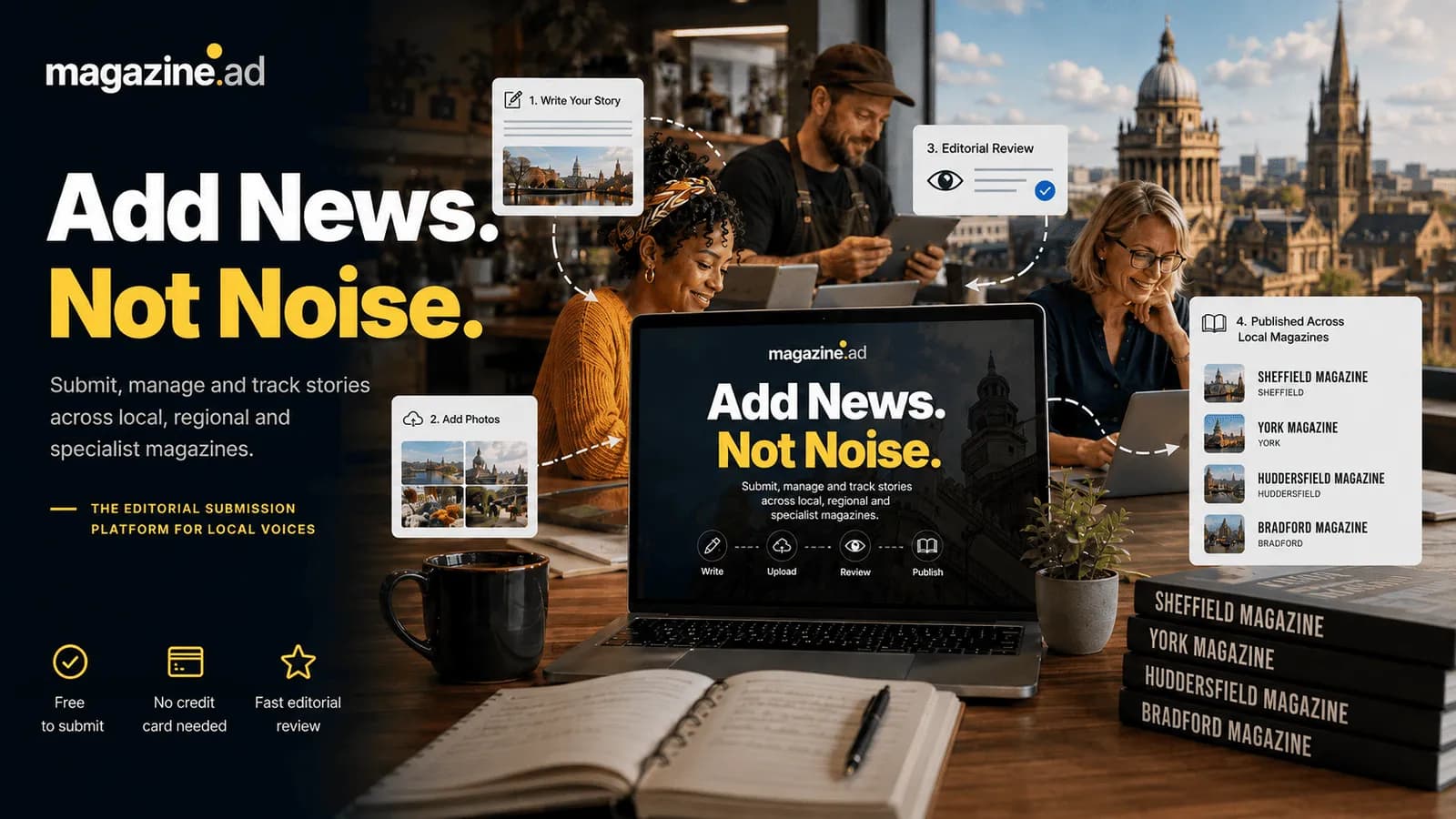
That is one of the reasons Leeds Magazine now uses magazine.ad, a dedicated editorial platform that gives people one place to submit stories directly for consideration.
And increasingly, some of the stories readers are seeing on Leeds Magazine are arriving that way.
Recent examples include Cross Gates illustrator Darren Scotland's collection celebrating 12 local independent businesses and Leeds Jewish Housing Association's story marking the opening of 28 new affordable family homes in the north of the city.
Both came into Leeds Magazine through magazine.ad before being reviewed and published by the editorial team.
That's exactly what the platform was built to do.
Making it easier to tell us what is happening in Leeds
There is no shortage of interesting things happening across Leeds.
Every week there are new businesses opening, community projects getting started, fundraising efforts, exhibitions, school achievements, charity campaigns, events, local success stories and people doing things that deserve a bit more attention.
The difficulty for local publishers has traditionally been getting all of those stories into one sensible place.
Email worked when there were a handful of submissions.
It becomes considerably less useful when photographs are in one email, the press release is in another, somebody replies from a different address and the original message is gradually buried beneath everything else arriving that day.
magazine.ad gives contributors a different route.
Create an account, choose the publication, add the story and photographs and send it directly into the editorial system.
For somebody in Leeds, that means being able to choose Leeds Magazine and submit directly to our team without needing to know which editor happens to be working that day.
The story then has an actual status.
It can be saved as a draft, submitted for review, picked up by an editor, returned if something needs clarifying and ultimately moved through to publication.
For the person who sent it, there is a much clearer answer to the old question:
"Did anybody actually get my story?"
More than 1,600 pieces of content have already gone through the system
The platform has grown quickly since opening to contributors.
More than 750 people and organisations have registered, with well over 1,600 pieces of content entering the editorial system so far.
Those contributors range from individuals and community groups to charities, businesses, public organisations and professional communications teams.
And the numbers continue to move.
On 2 September alone, the live platform was processing new contributor registrations, new submissions entering editorial review and stories moving through to publication.
It is becoming less of an experiment and more of the everyday infrastructure behind the magazines.
And there is a fairly simple reason for that.
1,600 emails is an inbox problem.
1,600 organised submissions is an editorial system.
You don't have to be a PR professional
One of the things we are particularly keen to avoid is creating the impression that local publishing is only for organisations with communications departments.
It isn't.
Some magazine.ad users submit stories professionally every week.
Others might use it once.
A local resident with photographs from something unusual happening in their neighbourhood is just as capable of giving us the beginning of a great Leeds story as a national PR agency.
The important part is the story.
Is it relevant to Leeds?
Is it interesting?
Does it tell readers something useful, surprising, positive or important about the place they live?
If the answer is yes, we want people to feel comfortable sending it.
You don't need to know somebody at Leeds Magazine first.
You don't need to understand how a newsroom works.
And you don't need to write like a journalist.
Tell us what happened, give us the useful details and photographs where possible, and the editorial team can take it from there.
It doesn't mean everything submitted is automatically published
There is an important difference between easier submission and automatic publication.
magazine.ad is not an open publishing platform where pressing a button immediately puts something onto Leeds Magazine.
Every submission still goes through editorial review.
Some stories need more information.
Some need a stronger Leeds connection.
Some are better suited to another publication.
And occasionally something simply isn't suitable for publication.
That editorial judgement is still important.
The technology is there to make the journey to the editor easier, rather than remove the editor altogether.
That distinction matters to us.
Local journalism works best when the technology takes care of the repetitive administrative bits and leaves people to make the decisions that actually require local knowledge.
Useful for Leeds organisations too
The system is also proving particularly useful for organisations that regularly have legitimate local news to share.
Charities, universities, schools, cultural organisations, housing providers, local businesses and communications teams frequently have several different stories happening at once.
Instead of starting again every time, contributors can manage their submissions from one account and keep track of what has been sent.
Professional PR and communications teams can also use the same account across the wider magazine network.
That becomes particularly useful when a story crosses geographical boundaries.
Something happening specifically in Leeds belongs here.
A wider Yorkshire story may be relevant to several publications.
A national organisation might have separate genuinely local stories for Leeds, Newcastle, Manchester, Edinburgh and other areas.
The aim isn't to send everything everywhere.
It is to make it easier to get the right story to the right local publication.
Leeds is part of a much bigger local network
Leeds Magazine itself is now part of a growing network of more than 170 local and regional magazine publications.
The important word there is still local.
The goal isn't to turn those publications into one enormous generic news website.
Leeds Magazine should feel like Leeds Magazine.
Stories about Cross Gates, Chapeltown, Pudsey, Headingley, Harehills, Roundhay, Morley and communities across the city should be written because they matter to the people who live here.
What can be shared is the technology underneath it.
The submission system, contributor accounts and editorial workflow can work across the network while the actual journalism stays rooted in individual places.
That is what makes the model interesting.
And it is beginning to travel beyond the UK
The same idea is now being developed outside Britain too.
Firefly Magazines has begun building a network of English-language local publications in Poland, with cities including Poznań now using the same underlying editorial infrastructure.
In fact, a Poznań cultural story moved through magazine.ad and into publication on the same morning this article was being prepared.
Ireland is beginning to form another part of the network through Dublin Magazine, with the same principle: a local publication, a local audience and local editorial judgement supported by shared technology behind the scenes.
For contributors, the long-term idea is remarkably simple.
One account.
Lots of genuinely local publications.
And a much clearer route between having a story and reaching the people who might publish it.
Leeds stories still start with Leeds people
Technology can organise submissions.
It can send notifications.
It can keep photographs attached to the correct story and tell somebody when their article has moved into review.
What it cannot do is replace the person who notices something happening around the corner.
That is still where local news begins.
Someone sees a new project starting.
A parent thinks an issue isn't receiving enough attention.
A business owner reaches a milestone.
A charity achieves something extraordinary.
An artist creates something people locally would love.
A community decides to do something together.
And somebody thinks:
Leeds should know about this.
We want the next step to be the easy part.
If you have a story, event, photograph, community update or something interesting happening anywhere across Leeds, you can submit it directly to the Leeds Magazine editorial team through magazine.ad.
Because Leeds has never had a shortage of stories.
We just want to make sure the good ones have somewhere to go.